How to migrate from Stoplight to Scalar
Last updated: September 2026
Stoplight built a well-loved API design platform: a visual OpenAPI editor, hosted docs, Spectral linting, and Prism mocking. SmartBear announced it was acquiring Stoplight on August 22, 2023. Stoplight is still sold today, with a free plan and paid tiers, and we have not found an official end-of-life notice from SmartBear. Some in the community have noticed a slowdown, though. APIs You Won't Hate wrote in October 2025 that "work on Stoplight appears to be slowing" as SmartBear folds its features into API Hub.
If that has you looking around, Scalar is a natural fit because the features and workflows line up closely:
- Generating interactive API reference docs from OpenAPI.
- Support for Markdown guides.
- Works with both Design-first or Code-first API workflows.
- Built-in team collaboration.
- Custom domains, theming, and logos.
- Hosted or embeddable as web or React component.
On top of this, Scalar provides:
- A free plan. Scalar's free plan covers up to 3 APIs with 1 editor seat, and Pro is $150/month ($125/month billed yearly) with 5 editor seats included. To be fair, Stoplight's paid plans start lower: as of September 2026, Stoplight Basic is $44/month billed annually for 3 users, and Startup, which adds custom domains, is $113/month billed annually for 8 users.
- Open source. Scalar's API Reference and API Client are MIT licensed and can be self-hosted. Stoplight's Elements, Spectral, and Prism are open source too, under Apache 2.0, so if you only use those, you may not need to move at all.
- Built-in API client. Scalar has an API client built into the API reference, so readers can send test requests straight from the docs.
- SDKs and MCP servers. Scalar generates SDKs (TypeScript, Python, Go, Java, Kotlin, Ruby, and CLI are generally available; C#, PHP, Rust, Swift, Dart, and C++ are experimental) and hosts MCP servers from the same OpenAPI document.
How does migrating work?
With Stoplight and Scalar offering quite a few features on top of the "turn OpenAPI into docs" use case, a migration can feel daunting. It breaks down into manageable steps. Generally it looks a little like this:
- Move OpenAPI documents over.
- Link up your Git repos.
- Make sure you like the look of the new API documentation.
- (Optional) Migrate Markdown topics and guides.
- (Optional) Move custom linting rulesets over.
- (Optional) Point custom domains to Scalar.
- (Optional) Set up redirects from old Stoplight docs to new Scalar docs.
Before we get stuck into the technical aspects, let us consider how Scalar fits into the larger workflow.
API Design-first or Code-first
Some API teams generate OpenAPI from code, whether that is code annotations or comments, a DSL like RSwag, or increasingly popular OpenAPI-aware frameworks. Whichever tool is being used, the process is generally the same.
Those documents being generated then committed to Git, by some sort of build script or continuous integration. Scalar can happily read those same committed OpenAPI and Markdown content from Git.
If the generated OpenAPI is being powered by Stoplight CLI without Git then that could be a straight swap to use the Scalar CLI to push documents to the Registry (or run both for a while and see how things look.) Or you could take the chance to migrate to using Git, as it is generally considered best practice to keep the OpenAPI/Markdown alongside the source code.
Teams following the design-first workflow with Stoplight are probably using the OpenAPI editor Stoplight Studio, either the desktop application or the hosted editor in Stoplight Platform. Scalar has an editor in the dashboard which can be used in the same way, allowing for changes to be made and pushed to the Registry, and/or synced back to Git. The registry makes OpenAPI documents available for other tools in the workflow, so they can access the latest OpenAPI, or peg to a particular version.
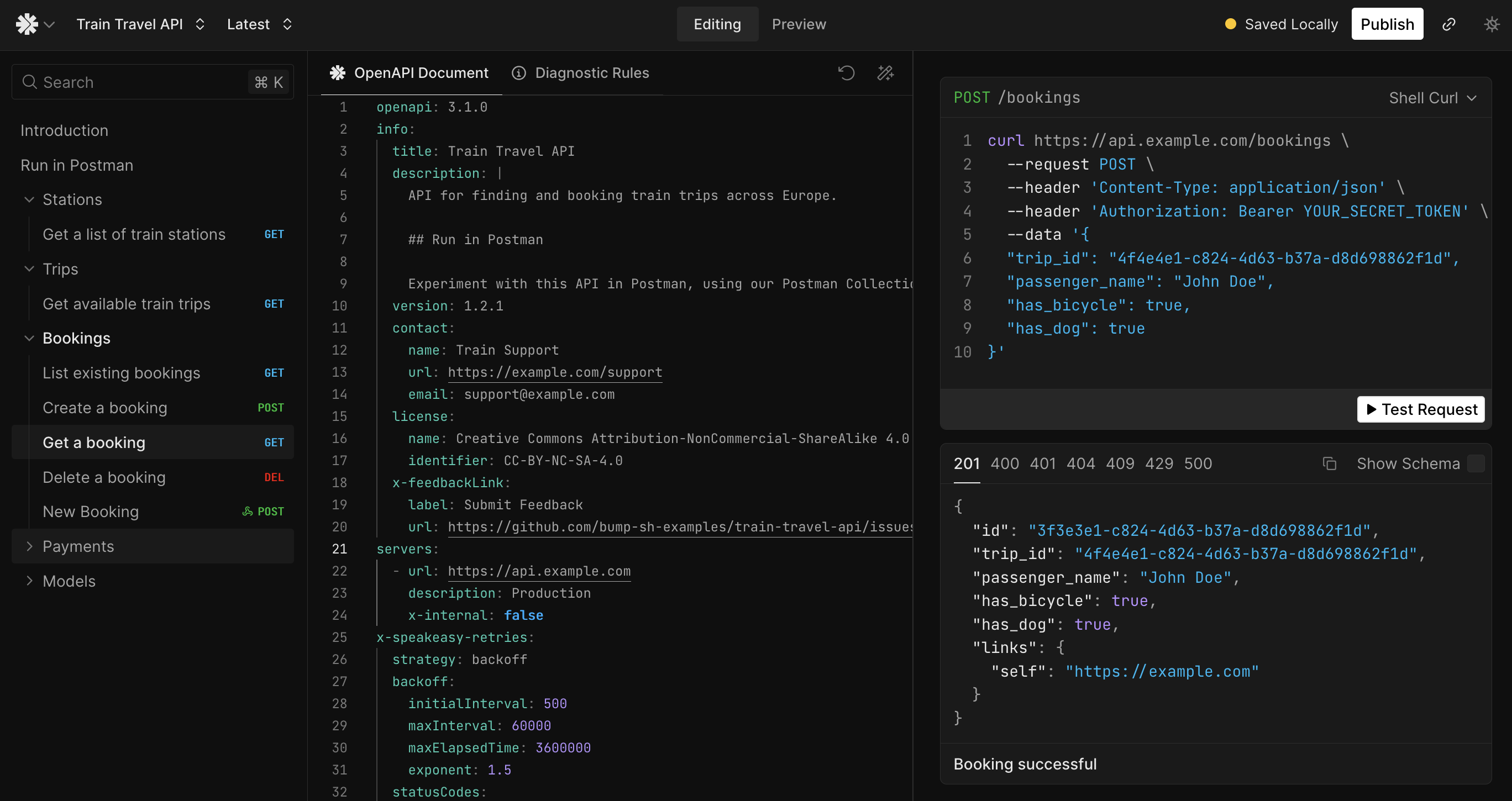
With that in mind, let us look at how to make the switch.
Step 1: Create a free Scalar account
Scalar has a free tier, and you can get quite a lot done with it. No credit card needed, just register over here.
Step 2: Introduce your OpenAPI to Scalar
Stoplight had various flavors of project: Web Projects, Git Projects, Local Projects. We are going to make life easy and show you all how to convert to Git projects, and you can play around with other approaches once you have got the hang of the basics.
Git Projects
Migrating a Stoplight "Git Project" is as simple as enabling GitHub Sync for Scalar. Stoplight was just pushing and pulling from a Git repo, and Scalar can do that too. This is built in, not some awkward GitHub Action.
To use GitHub Sync go to the dashboard, click Create Documentation, then select GitHub Sync. Pick the appropriate organization from the dropdown and find the repository to link.
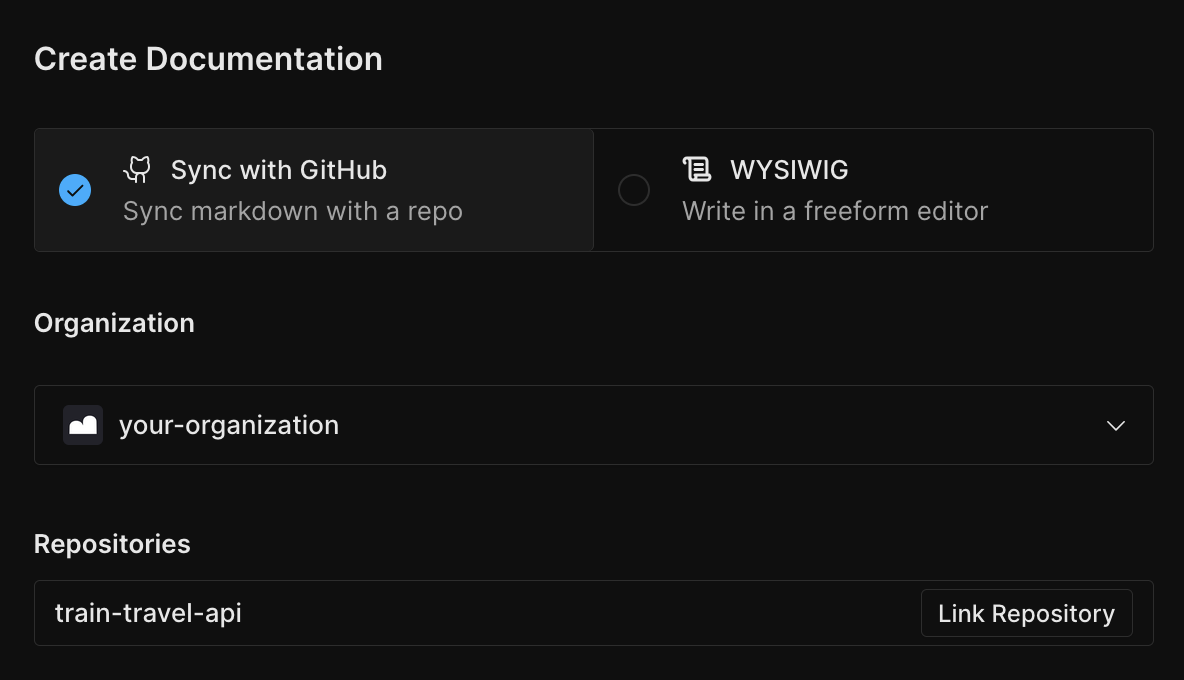
Click the Link Repository link next to the repository of interest, and a page with some GitHub Repository Settings will appear. The defaults are probably all fine, but perhaps you are using a special branch called docs or a particular version branch like v3 instead of main.
All of this can be changed later so pick whatever and click publish, it will be private by default so no worries about anyone seeing anything that is not ready.
Web Projects: Exporting Stoplight Web Projects
Exfiltrating your OpenAPI and Markdown from Stoplight is as simple as exporting a ZIP file of your OpenAPI and other documents.
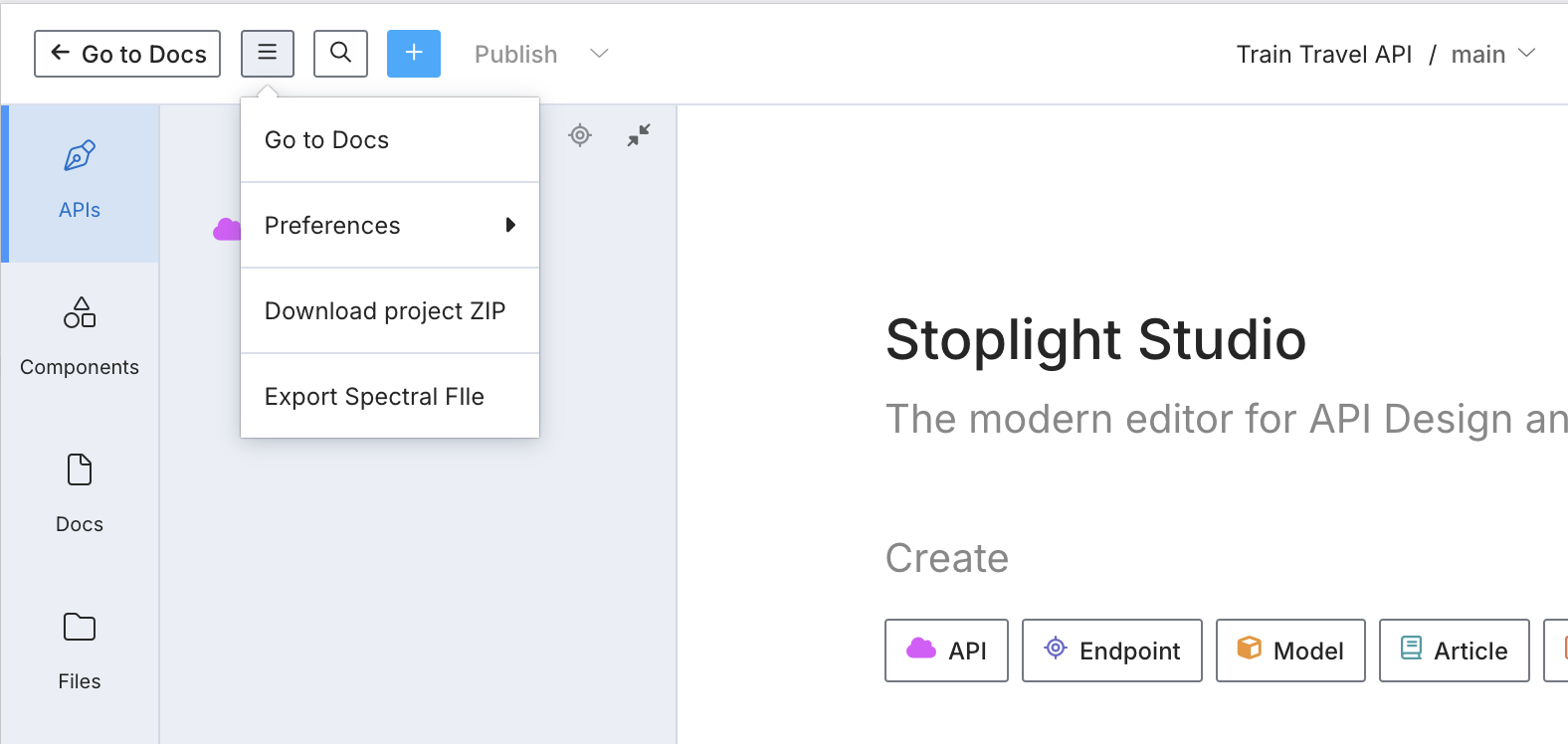
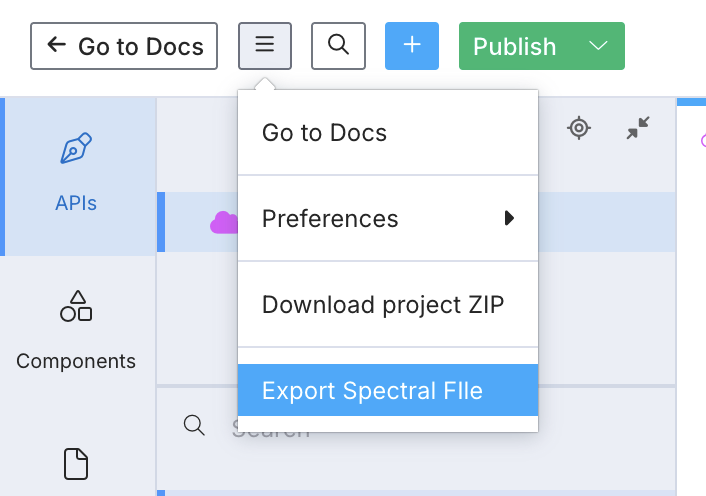
Go to your project’s studio page, and click the three line drop down to reveal the Download project ZIP option.
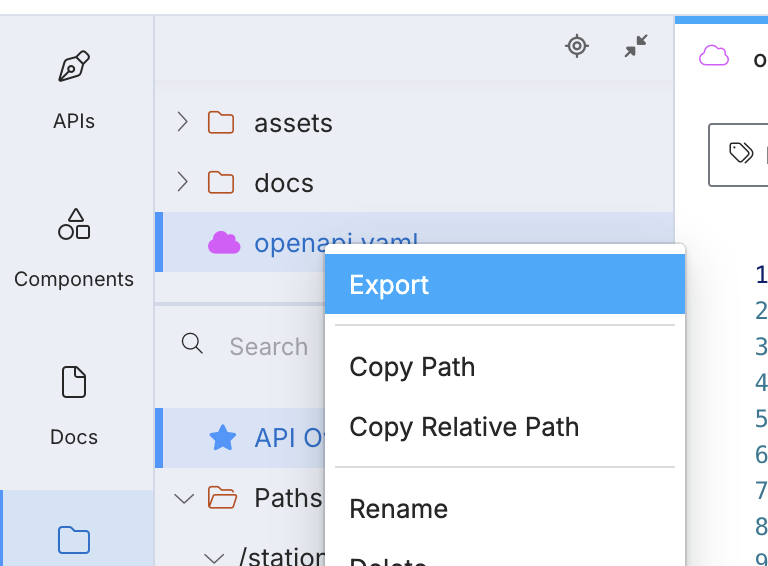
If you only want the OpenAPI document, you could just go to your doc page, click Export and then choose Bundled to make sure you get any $ref to other files included.
Let us switch these to Git Sync projects to keep the source of truth entirely under your control. To do this we can create a new repository to help track changes, or merge the downloaded OpenAPI/Markdown into the existing source code repository.
Whichever approach you pick, once you have got the OpenAPI/Markdown content into a repository, you can scroll up to the Git Sync section in this guide to bring that repo into Scalar.
Step 3: Scalar Config
Once the project is hooked up to Scalar, the next step is to set up the Scalar config file. By creating a scalar.config.json file we can add the details on where the OpenAPI documents live, and where the guides are sitting.
{
  "$schema": "https://registry.scalar.com/@scalar/schemas/config",
  "scalar": "2.0.0",
  "siteConfig": {
    "subdomain": "name-of-your-api"
  },
  "navigation": {
    "routes": {
      "/": {
        "type": "group",
        "title": "Train Travel API",
        "children": {
          "/guides": {
            "type": "group",
            "title": "Guides",
            "children": {
              "getting-started": {
                "type": "page",
                "filepath": "docs/getting-started.md",
                "title": "Getting Started"
              }
            }
          },
          "/api": {
            "type": "openapi",
            "filepath": "openapi.yaml",
            "title": "API Reference"
          }
        }
      }
    }
  }
}
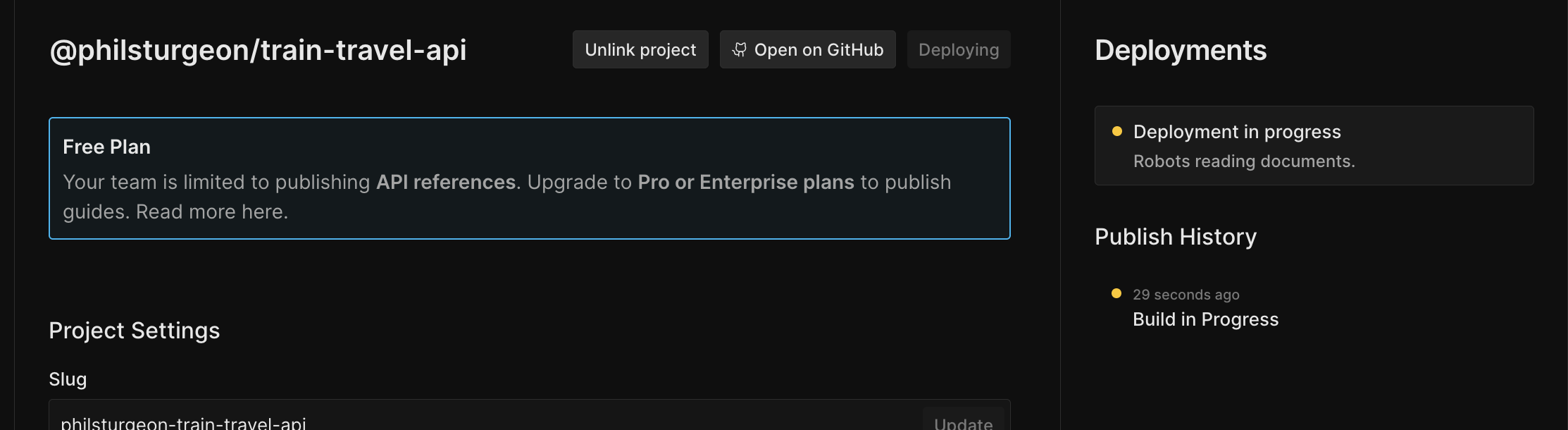
Configure automatic deployment (publish when a branch is merged into your selected branch) in the Scalar Dashboard under your project settings.
The Stoplight sidebar content can be found in toc.json, and converted in your favorite text editor.
Take this example toc.json from a Stoplight project.
{
  "items": [
    {
      "type": "item",
      "title": "Getting Started",
      "uri": "docs/getting-started.md"
    },
    {
      "type": "item",
      "title": "Hello World",
      "uri": "docs/hello-world.md"
    }
  ]
}
Copy and paste that chunk of JSON out of there, and make the following changes.
- Change
type: itemtotype: page. - Change
uritofilepath. - Keep the
titlefield.
{
  "$schema": "https://registry.scalar.com/@scalar/schemas/config",
  "scalar": "2.0.0",
  "siteConfig": {
    "subdomain": "name-of-your-api"
  },
  "navigation": {
    "routes": {
      "/": {
        "type": "group",
        "title": "Train Travel API",
        "children": {
          "/guides": {
            "type": "group",
            "title": "Guides",
            "children": {
              "getting-started": {
                "type": "page",
                "filepath": "docs/getting-started.md",
                "title": "Getting Started"
              },
              "hello-world": {
                "type": "page",
                "filepath": "docs/hello-world.md",
                "title": "Hello World"
              }
            }
          },
          "/api": {
            "type": "openapi",
            "filepath": "openapi.yaml",
            "title": "API Reference"
          }
        }
      }
    }
  }
}
You can create more complex sidebars with nested pages and more. See this example scalar.config.json to see how it works.
Commit this file and push. If automatic deployment is enabled in the Scalar Dashboard under your project settings, a new entry under Deployments will appear once the branch is merged; when that is done you can see how it all looks.
Step 4: Review The New Documentation
Click the deployment to find the project's docs URL, something like https://name-of-your-api.apidocumentation.com.
This will show two distinct sections.
- Guides
- Each OpenAPI Reference
Projects with multiple OpenAPI documents will see each of them popped along the top navigation, using the name provided in scalar.config.json.
Click around. See how you like the place. Enjoy the slick new interactive API console on each endpoint.
Step 5: (Optional) Export Spectral ruleset
This step is only for those using custom Spectral rulesets. If you have never heard of them, you probably were not using them.
Spectral is the open-source linter Stoplight created, now Apache 2.0 licensed under SmartBear. By default it reports on whether an OpenAPI document is valid, whether it has syntax errors or invalid keywords, so if you were using Stoplight Studio and seeing "Missing required keyword" type errors; that was Spectral. Scalar supports Spectral so you will continue to see the same errors and warnings in Scalar Editor.
That might not be the end of the story though, as Spectral also supports custom rulesets. These are most often built by API governance teams, or other tech-minded folks who want to ensure consistency across the APIs being designed. The rulesets could be automating API Style Guides, pushing people towards standards, or away from poor practices.
To migrate any custom Spectral rulesets hosted in Stoplight Platform, head to Studio, and click Export Spectral File.
Maybe this is just turning some rules on and off.
Maybe it is defining custom rules.
Be aware rules with custom functions will not work, so just comment those out.
Step 6: (Optional) Update Custom Domains
Once you are happy with your new API documentation, it is time to bring the API client developers along too. Those of you with a custom domain pointing to Stoplight (something like developers.acme.com) can update the CNAME to point to Scalar.
First off, add the custom domain to your Scalar config.
// scalar.config.json
{
  "siteConfig": {
    "subdomain": "name-of-your-api",
    "customDomain": "docs.example.com"
  }
  // ...
}
Then pop over to your DNS and update the CNAME from developers (or whatever your subdomain is) from the old Stoplight DNS to dns.scalar.com. Give it a few minutes and it should be ready to go.
Step 7: (Optional) Add Redirects
If you had a lot of traffic going to your Stoplight docs, you might want to set up some redirects to make sure existing links keep working. Scalar supports redirects via the siteConfig.routing.redirects configuration in scalar.config.json.
If you were using a custom domain with Stoplight hosted documentation then the paths will be passed to Scalar after Step 6. This means Scalar's redirects can be used to point old paths to new ones.
// scalar.config.json
{
  "siteConfig": {
    "routing": {
      "redirects": [{
        "from": "/docs/<stoplight-project>/10a1321b3-:wildcard",
        "to": "/guides/getting-started"
      }]
    }
  }
  // ...
}
Learn more about redirects.
Summary
The biggest advantage in this migration is that both tools are fundamentally OpenAPI-based, which means your core specifications will transfer cleanly.
Most teams can complete this migration in somewhere between a few hours and a few days, depending on how many projects and APIs need moving over. Larger enterprises will take slightly longer depending on the complexity of their API ecosystem.
Scalar's team is happy to offer migration assistance and consultation to help streamline this process, particularly for teams with complex Stoplight implementations. Talk to us if you would like help.
Frequently asked questions
Is Stoplight being shut down?
We have not found an official end-of-life announcement from SmartBear, and Stoplight's pricing page still sells free and paid plans as of September 2026. Community writers have noted slower development since the 2023 acquisition, so it is reasonable to plan ahead, but there is no deadline forcing a move.
Will my Spectral rulesets work in Scalar?
Yes, for the most part. Scalar supports Spectral, so exported rulesets carry over. Rules that rely on custom JavaScript functions will not run, so comment those out and replace them where you can.
Do I need to change my OpenAPI documents to move from Stoplight?
No. Both tools are OpenAPI-based. Export your documents bundled so any cross-file $ref values come with them, or connect the same Git repository to Scalar.
How do I convert Stoplight's toc.json into Scalar navigation?
Copy each item into the navigation.routes section of scalar.config.json, change type: item to type: page, and rename uri to filepath. Step 3 above walks through an example.
Does Scalar replace Prism mock servers?
Scalar has its own mock server that generates responses from your schemas, which you can run with npx @scalar/cli document mock openapi.json. Prism is open source, so you can also keep running it alongside Scalar.
Related
- Learn: Spectral rules · API mocking
- Docs: Stoplight alternatives · Scalar vs Stoplight comparison · Docs configuration
- Product: Scalar Docs — Git-synced docs and API references, the closest match to Stoplight's hosted docs
Stoplight details on this page come from its pricing page, SmartBear's acquisition announcement, and Stoplight's GitHub repositories as checked on September 26, 2026. We could not find an official statement on Stoplight's long-term future and have said so rather than guess. If something here is wrong or out of date, please open an issue and we will correct it.