Scalar API Client release notes
macOS 13 requirement and authentication polish
The desktop app now requires macOS 13 or later after updating to Electron 44. This release also brings authentication improvements and editor fixes from the API Client.
- Updated to Electron 44.5.1, which requires macOS 13 or later
- Fixed large request bodies rendering blank gaps when scrolling in the code editor
- Made authentication field clearing consistent with separate reset actions for configured defaults
- Polished the bearer token acquisition row to match the design of surrounding elements
- Fixed long unbroken lines in request bodies stretching the client beyond the viewport
Import Hono reference pages and accessibility improvements
This release brings support for importing API descriptions from Hono reference page URLs and includes accessibility fixes for code blocks and keyboard navigation.
- Import API descriptions directly from Hono reference page URLs, with automatic document discovery and watch mode support
- Screen readers now announce code blocks with their language and context, such as "Code sample: Shell cURL"
- Copy buttons in code blocks have stable accessible names that remain clear even when the visible label is hidden
- Press Space to toggle options in multiselect comboboxes like the auth scheme picker without hiding the list
- Update the desktop app’s Undici dependency to 8.11.2 to address security advisories
Improved request body editing and clearer error handling
This release makes it easier to work with array-based enum selections in request bodies, removes unnecessary authentication dropdowns, and provides better visibility when requests fail due to CORS or network issues.
- Enum array selections now preserve their original types (numbers, booleans, strings) when editing request bodies in the Form view
- Failed requests remain visible with guidance about possible CORS or network causes instead of disappearing after a toast message
- Authentication dropdowns are hidden when only one required option is available, reducing visual clutter in the API Reference
- Long enum selection labels now stay contained within their controls
- Search performance improvements reduce unnecessary allocations during document search
OAuth reliability improvements and accessibility refinements
This release resolves OAuth configuration bugs that caused redirect URLs to be lost and scope selections to duplicate, while incorporating a comprehensive set of screen reader and keyboard accessibility improvements throughout the testing client.
- OAuth redirect URLs now persist when changing credentials or clearing tokens, and refresh controls appear only when a refresh token is available
- Selecting OAuth scopes no longer creates duplicate entries, and configured default scopes are applied automatically
- Auth fields now expose their visible labels to screen readers in both masked and unmasked states
- Opening the test modal moves focus to the close button first, and request filter tabs announce each option once instead of twice
- At narrow widths, the modal header keeps the method label inside the address bar and the sidebar toggle moves to the backdrop as a circle
Desktop login fixes and improved form handling
This release resolves desktop login callback issues and brings several improvements to the API client, including better form field handling and response display on narrow screens.
- Fixed desktop login callback port allocation and CORS configuration so authentication works reliably
- Selecting files or editing optional form fields now automatically includes them in requests
- Long response bodies remain scrollable in narrow layouts instead of expanding the entire panel
- XML examples now generate correctly from schemas with proper attribute and namespace support
- Mock server XML responses preserve schema metadata and report generation errors through headers
OpenAPI 3.2 support for custom methods and query parameters
This release adds OpenAPI 3.2 features to the API client, including support for custom HTTP methods like PURGE and QUERY, whole-query parameters, and improved parameter examples. SDK code samples now follow the example switcher, and several hydration and rendering issues have been resolved.
- Custom HTTP methods from additionalOperations now appear in navigation and the method picker, with case-sensitive spelling preserved in requests and code samples
- Whole-query parameters (in: querystring) can now be edited, validated, and sent with proper content-based serialization and percent-encoding
- SDK code samples follow the request example switcher and show localized status messages when a linked sample is unavailable
- Parameter examples using dataValue and serializedValue now work correctly in the editor, outgoing requests, and code snippets without double-encoding
- Fixed server-side rendering hydration issues for auth forms, accordion headers, and initial sidebar selection
OpenAPI 3.2 support with streaming responses and device authorization
This release adds comprehensive OpenAPI 3.2 support, including streaming response rendering, OAuth device authorization flows, and multilingual UI translations. The editor now validates and suggests OpenAPI 3.2 features while continuing to accept existing 3.1 documents.
- Display JSON Lines, JSON Sequences, and multipart response parts as they arrive with cancellation support and bounded display limits
- Support OAuth device authorization flows with verification codes, cancellable token polling, and stored credentials
- Localize the API Client in eight languages including English, Russian, Spanish, French, German, Chinese, Arabic, and Portuguese
- Preserve OpenAPI 3.2 fields such as streaming item schemas, tag hierarchy, nested encoding, and additional operations
- Fix duplicate parameter rows and lost focus when editing request headers, cookies, and query parameters
Smarter parameter handling and faster example loading
This release improves how the API client handles optional parameters with pre-filled values and makes working with large API descriptions much faster by loading external examples only when needed.
- Optional parameters with default or enum values are now automatically enabled so they are included in your requests
- External examples load on demand when you view them, making the client faster when working with APIs that have thousands of examples
- Example payloads are cached and shared across the interface to reduce network requests
Line wrapping toggle and OAuth2 metadata discovery
This release adds interactive line wrapping for long request and response bodies, OAuth2 authorization server metadata discovery, and several polish fixes for the API client modal and authentication flows.
- Toggle line wrapping in request and response bodies to view long strings without horizontal scrolling
- OAuth2 flows now support metadata URLs to automatically discover authorization endpoints
- Copy button added to the request body editor for quick clipboard access
- OpenAPI 3.2 response summaries, server names, and deprecated security scheme indicators now render correctly
- Fixed the API client modal showing no operation when reopening a document's first request
Improved workspace settings, authentication, and request handling
This release fixes workspace settings visibility issues, improves request body handling with schema generation and multipart arrays, and preserves mutual TLS security scheme types with read-only authentication guidance.
- Fixed workspace settings options becoming unreadable while clicked, and made light theme color swatches visible
- Added a button to generate request body examples from schema when custom examples hide schema fields
- Optional query parameters and form body fields are now automatically enabled when you enter a value
- Request duration is now available in post-response scripts as response time in milliseconds
- Multipart form arrays are now sent correctly as separate parts with the same field name
Form view improvements for request bodies
This release adds control over the default request body editor view and fixes how optional form fields are handled.
- You can now default the request body editor to Form view using the defaultRequestBodyView config option or the x-scalar-default-request-body-view extension in your OpenAPI document
- Optional form-body properties (multipart/form-data and application/x-www-form-urlencoded) now start unchecked and are only sent when you enable them, matching how optional parameters already work
Header layout polish and request body fix
This release fixes the app header overflowing on mobile and resolves an issue where clicking Test Request could discard your edits when the operation was already open.
- Fixed the app header overflowing the viewport on smaller screens
- Clicking Test Request no longer throws away your edited request body when reopening the same operation
- Added support for testing OpenAPI webhooks from both the API reference and API client
- Reduced the standalone bundle size by 18 KB gzip by removing duplicate dependencies
Polish and bug fixes shipped
Fixes for request parameters and schema switching
This release addresses several issues with parameter display and request body handling in the API client. Parameter names now appear correctly on first load, and switching between schema options properly resets edited examples.
- Fixed parameter names appearing blank when first opening the Try It panel for GET endpoints
- Fixed header parameters showing as empty rows when viewing operations after one with a request body
- Reset edited request body examples when switching between oneOf or anyOf schema options
- Improved stability of parameter row rendering using consistent component keys
OAuth2 flow control, NDJSON support, and environment variables in scripts
This release adds OpenAPI extensions to customize OAuth2 flows, renders NDJSON responses instead of showing a binary file placeholder, and fixes environment variables so they work correctly in pre-request and post-response scripts.
- Use x-order to control the order of OAuth2 flow tabs, and x-scalar-ignore to hide flows that cannot run in the browser (like Client Credentials) or entire security schemes from the auth selector
- NDJSON responses (application/x-ndjson or application/ndjson) now render as text with each JSON record pretty-printed in the preview
- Environment variables now work in scripts: pm.environment.get() reads the active environment, and pm.environment.set() persists values like bearer tokens so they survive to the next request
Cookie preset switcher and API improvements
This release introduces a streamlined way to work with global cookies that share the same name, alongside fixes for header parameter behavior and multipart file display.
- Global cookies with the same name now collapse into a single row with a dropdown to switch between preset values (e.g. Culture: PL or EN), sending only the selected value.
- Header parameters with x-disabled: false now stay enabled while editing, fixing a bug where optional headers were incorrectly reset on every keystroke.
- Long file names in multipart forms now truncate with an ellipsis instead of overflowing, with the full name visible on hover.
- Plugins can now access the active server and custom fetch implementation in the beforeRequest hook for resolving relative URLs and making network calls.
- Updated build and runtime dependencies to their latest compatible versions for improved stability.
OAuth2 improvements, form editor for JSON bodies, and AsyncAPI broker auth
This release adds a form view for JSON and YAML request bodies, brings OAuth2 token acquisition directly to bearer auth schemes, and adds credential inputs for all AsyncAPI broker security types.
- JSON and YAML request bodies now have a form view with dropdowns, required badges, and per-field validation — switch between Form and Raw with a single click
- Bearer auth schemes can now acquire tokens through OAuth2 flows without switching auth methods, with an inline Authorize button and automatic token routing
- All eight AsyncAPI broker security scheme types (SASL, X509, encryption, GSSAPI) now have dedicated credential input forms
- Confidential OAuth2 clients can now use PKCE together with a client secret, following RFC 9700 recommendations
- OAuth2 scope selection no longer drops changes when clicking checkboxes quickly, and checkboxes include accessible labels for screen readers
Polish and bug fixes shipped
Border radius now scales from a single theme variable
Setting a custom border radius in your theme is simpler and more predictable. Override --scalar-radius once to rescale every corner in the interface, including buttons, inputs, and panels. Setting it to zero now produces a fully squared-off UI.
- Border radius tokens now derive from --scalar-radius, so changing one variable rescales the entire interface
- Setting --scalar-radius to zero produces a fully square theme with no rounded corners
- Two new radius tokens added: --scalar-radius-2xl (12px) and --scalar-radius-3xl (16px)
- Replaced hardcoded border radius values throughout the UI with theme tokens
Clearer authentication warnings
Authentication warnings now name the document type and distinguish unsupported authentication types from security schemes with a missing type.
- Authentication warnings now correctly identify the document type (AsyncAPI or OpenAPI) instead of always saying OpenAPI
- Unsupported AsyncAPI authentication types now show a clear message indicating the feature is not yet supported
Cookie persistence and auth selector polish
This release fixes cookie handling so server-set tokens like Django CSRF survive page reloads, and removes confusing delete buttons from read-only security schemes in the API reference.
- Response cookies (such as Django csrftoken) now persist across page reloads and are replayed on later requests
- Auth selector no longer shows delete buttons for security schemes that cannot be removed
OAuth2 flows and URL imports now work in the desktop app
Interactive OAuth2 (authorization code and implicit flows) never actually worked in the desktop app because the renderer runs on file:// URLs. This release adds loopback redirect support so you can complete OAuth2 flows through your system browser.
- OAuth2 authorization code and implicit flows now work via a local loopback server that captures the redirect from your system browser
- Importing OpenAPI documents from a URL no longer fails with a Content Security Policy error
Synced example pickers and improved array parameter display
Example selections now sync across all operations, making it easier to see the same use case throughout your API. Array parameters in deepObject style also display with the correct trailing brackets to match the actual request.
- Selecting a request or response example now applies that choice to every operation that defines the same example
- Array parameters in deepObject style now show trailing brackets (like filter[ids][]) so the table matches the serialized request
- Editing array parameter values preserves the array type when writing back to the request
Request signing, auth token fixes, and parameter editing improvements
This release adds a new hook for request signing use cases, fixes auth tokens being dropped when document names contain spaces or special characters, and improves the behavior of query parameter renaming in the request editor.
- New requestBuilt hook and onRequestBuilt callback receive the exact fetch Request sent over the wire, making request body signing possible for multipart/form-data and other use cases
- Fixed Bearer tokens being dropped when documents loaded via sources have non-slug-safe names (spaces, special characters)
- Renaming auto-expanded query parameter keys now commits the change on blur and persists in both the request and table
- Header mutations in the new requestBuilt hook apply to the outgoing request (unlike onBeforeRequest which rebuilds after the callback)
- Query parameters not defined in the schema are now surfaced as their own rows after renaming
Editable Watch Mode sources and improved input performance
This release makes it easier to manage Watch Mode documents and improves responsiveness across request, authentication, and environment variable tables.
- Edit the Watch Mode source URL directly in document settings without needing to delete and re-import your collection
- Faster, more responsive input fields for parameters, headers, and environment variables with the new lightweight CodeInputLite component
- OAuth2 and OpenID Connect token requests now route through the desktop app's secure IPC layer
Path item references and SDK tab sync
This release fixes OpenAPI specs that use path item references and improves code example consistency across the client.
- Operations now appear correctly when OpenAPI paths use $ref to reference components.pathItems
- Authentication scheme dropdown now opens reliably when multiple API reference modals are present
- Selecting a language in Client Libraries now switches all operation code examples to that language
Polish and bug fixes shipped
SDK code samples, AsyncAPI servers, and form encoding fixes
This release adds support for SDK-generated code samples from popular tools, introduces an AsyncAPI server selector, and fixes how form data is sent to match your API specification.
- Read custom code samples from x-scalar-examples, x-stainless-snippets, x-stainless-examples, and x-readme.code-samples extensions
- Added AsyncAPI server selector with variable editing and persistence
- Fixed multipart and urlencoded form data to respect OpenAPI encoding styles like deepObject
- Simplified the client picker when only one option is available
Code splitting, WebSocket support, and performance improvements
This release introduces a new ESM standalone build with code splitting that reduces the initial bundle size by ~570 KB, adds WebSocket session support for AsyncAPI operations, and improves first-request performance when using scripts.
- New ESM standalone build with code splitting reduces initial load from 3.32 MB to 2.73 MB
- Fixed code samples with duplicate languages (like Python and Python Async) now appearing as separate selectable entries
- Scripts sandbox now warms up on mount to eliminate lag on the first request
- Added WebSocket session transport with plugin hooks for AsyncAPI operations
Script execution and build reliability improvements
This release fixes script execution in production builds and strengthens environment configuration validation to catch missing variables before deployment.
- Fixed pre-request and post-request scripts not running in production Electron builds
- Build now fails early when required environment variables are missing
- Added analytics tracking for document saves and registry sync operations
Logout now works correctly in the desktop app
We fixed a navigation issue that caused the Electron desktop app to break when logging out, and improved how environment variables are loaded across different build targets.
Improved multipart forms and better security
This release brings cleaner multipart form handling, better deep-linking from API Reference, and hardened security across the board.
- Nested object properties in multipart forms now expand into individual editable rows and serialize as clean JSON parts
- Opening the client from API Reference now lands you directly on the selected operation
- Response previews are now protected against XSS and referrer leakage
- Pre-request and post-response scripts run in an isolated sandbox, removing unsafe-eval from the main app
- Web client now defaults to proxy.scalar.com while desktop skips the proxy unless you configure one
Improved sidebar filtering and analytics fixes
This release brings better document organization with combined title and namespace filtering in the sidebar, plus fixes for analytics tracking and content security.
- Sidebar now filters documents by both title and namespace together with clearer controls
- Fixed analytics events not tracking login and logout actions
- Improved team picker to match dashboard design
- Relaxed image loading restrictions to support HTTPS sources
Scalar Client 1.0 — team workspaces, registry sync, conflict resolution, and a rebuilt experience
Intro walkthrough — What's new in Scalar Client 1.0
Scalar Client 1.0 is the first major release of the open-source HTTP client as a focused desktop and web app. Workspaces are now built around teams and the Scalar Registry: you can sync in real time, resolve conflicts when edits diverge, and manage API descriptions and versions without leaving the client. Local workspaces stay fast and offline-friendly with explicit save and revert before anything ships upstream.
Team workspaces and Scalar Registry
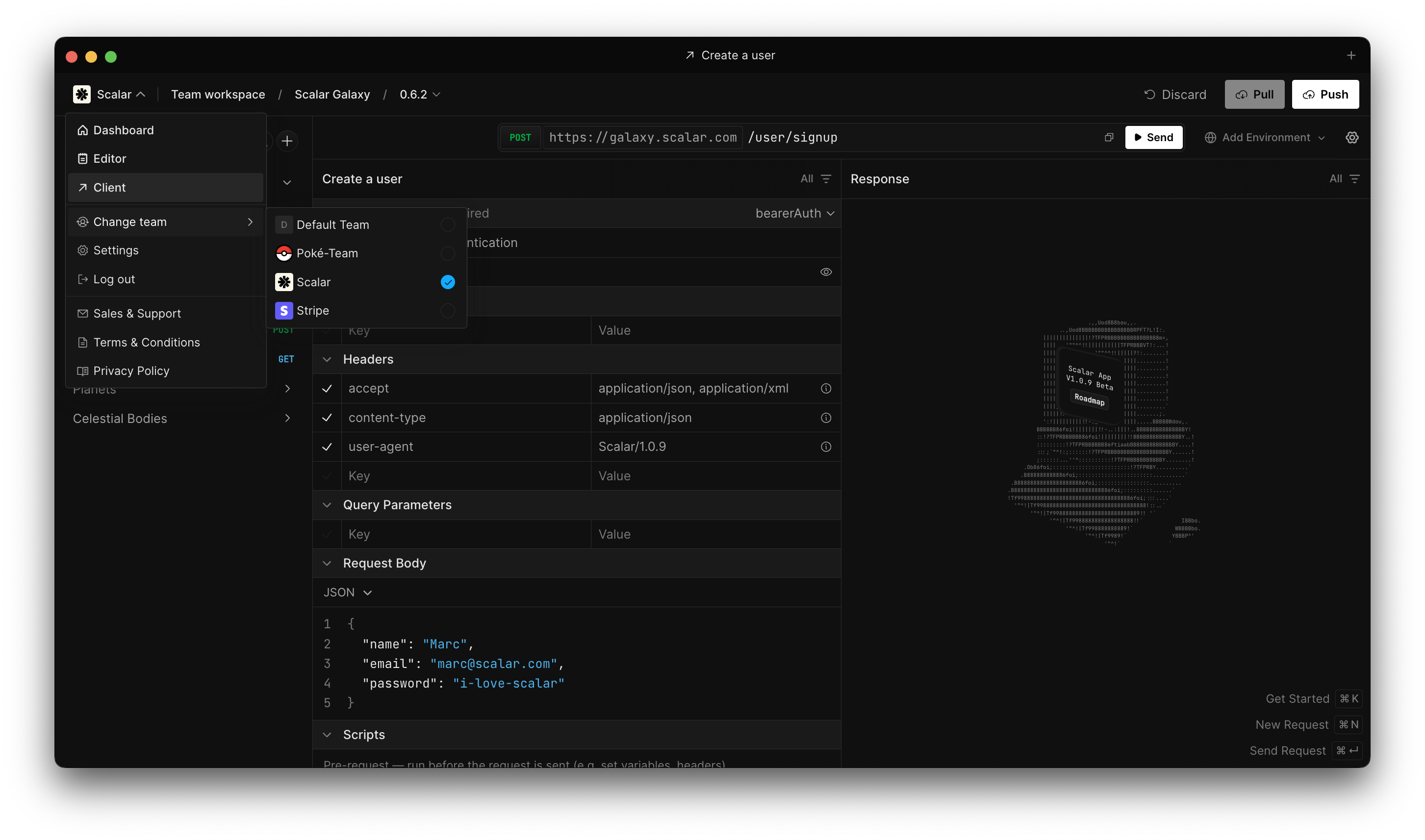
Team workspaces and Scalar Registry
- First-class team workspaces with a stable team identity that survives slug renames on the server.
- Live sync with the Scalar Registry so shared API descriptions stay aligned across machines.
- Conflict detection and resolution when local edits and registry changes disagree.
- Team switching from the header menu, with routing that follows the active team after sign-in.
- Returning to a workspace restores the tabs and routes you had open last time.
Local workspaces
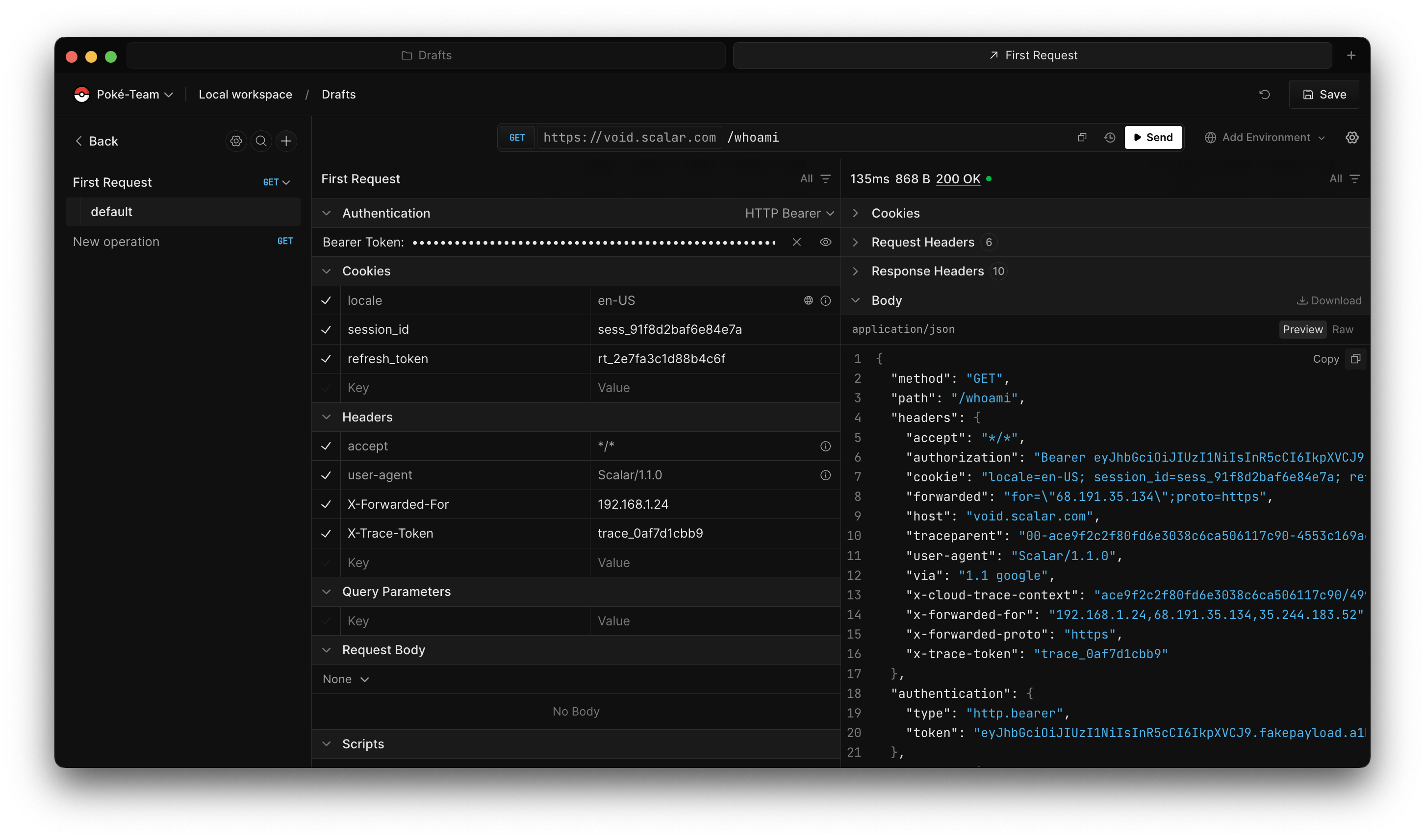
Local workspaces
- Save and revert flows for local-only drafts so you can experiment safely before publishing.
- Clear separation between personal local workspaces and team-backed workspaces.
- IndexedDB-backed persistence with a migration path from older localStorage installs.
Registry from the client
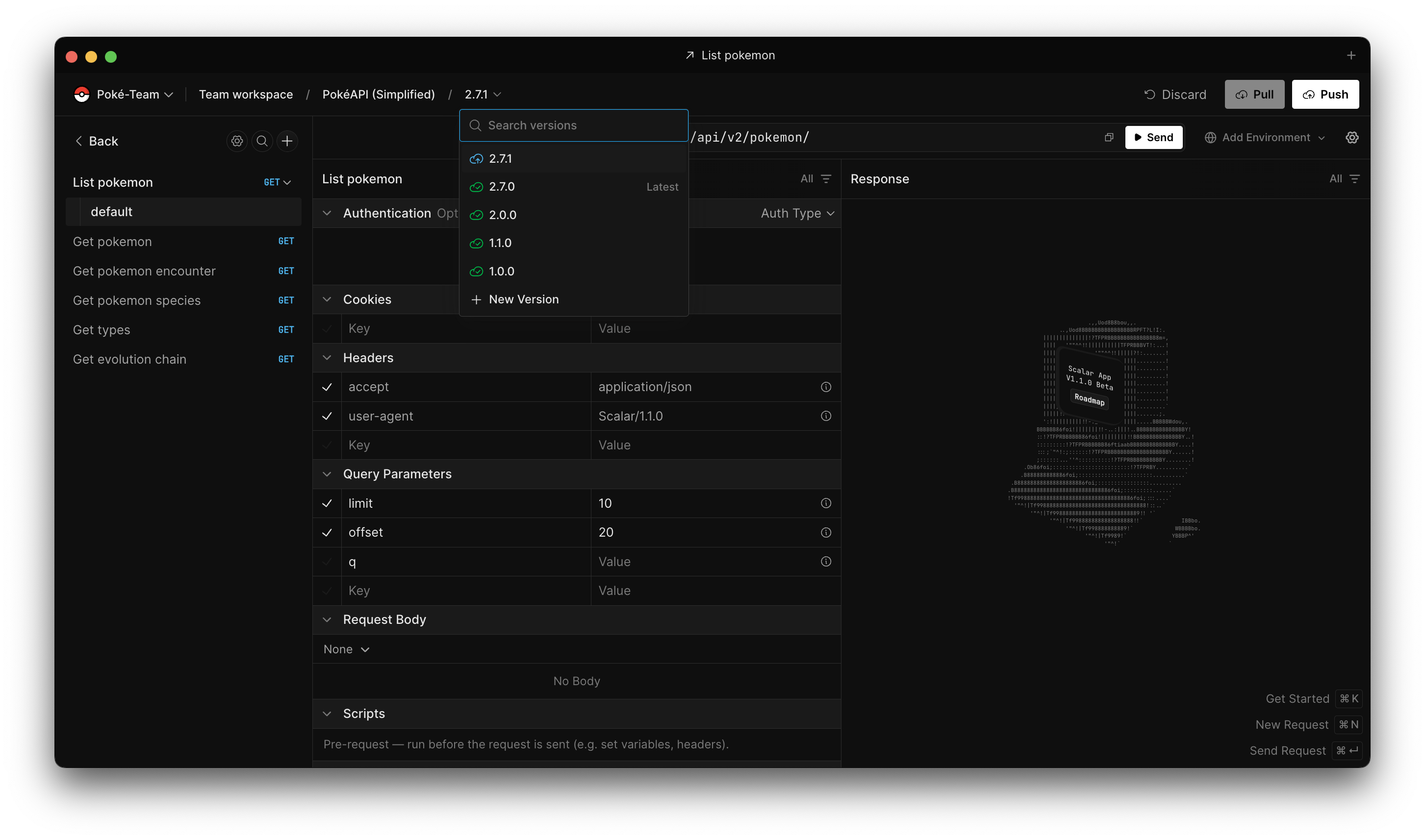
Registry from the client
- Add, update, and remove API descriptions tied to the registry without switching tools.
- Create and manage document versions from the same UI you use to send requests.
- Integrated registry adapter so the client speaks the same contracts as the hosted product.
Client shell, layout, and polish
- Layout tuned for small screens: breadcrumbs tuck away, workspace switching moves into the menu, and the address bar stacks cleanly with send actions.
- Command palette surfaces inline validation instead of silently disabling invalid actions.
- Electron window transparency and splash handling so team workspace reloads and resize flashes feel steadier.
- Monaco editor bundling moved to ESM-aligned workers for a more reliable desktop build.